
Guidelines for truck and trailer temperature mapping for GDP
Pharma logistics companies need a clear process for mapping refrigerated trucks and trailers that satisfies GDP auditors. Here is how to do it right.

Table of contents
Eagle Air Freight’s journey to GDP-ready temperature compliance
See how Eagle Air Freight conducts GDP-compliant truck temperature mappings and established compliance procedures fit for healthcare logistics.

What is truck and trailer temperature mapping?
Truck and trailer mapping is the process of placing calibrated data loggers inside a refrigerated vehicle to verify that it can maintain the required pharmaceutical storage temperatures uniformly throughout its cargo space.
The study identifies hot spots and cold spots, tests how the vehicle responds to operational stress events like door openings and reefer unit failures, and produces the documented evidence needed for GDP qualification. The results determine where to place permanent monitoring sensors and whether the vehicle is fit for pharmaceutical transport.
If you are familiar with warehouse mapping, the concept is the same. The difference is that trucks introduce a set of variables that warehouses do not have: shorter study windows, vibration, route variability, ambient temperature swings during transit, and the practical constraint that every hour a truck is parked for mapping is an hour it is not earning revenue.
Also see: Temperature mapping: Tips, frameworks, and pitfalls
Is mapping required for trucks and trailers?
Yes. If you use refrigerated vehicles to transport pharmaceutical products, temperature mapping is a regulatory expectation under GDP.
In the US, USP <1079> takes a risk-based approach, requiring documented evidence that temperature conditions are maintained during transportation. A proposed new chapter, USP <1079.5>, focuses specifically on transportation lane temperature mapping and qualification – a sign that expectations around transport validation are tightening.
The WHO Technical Report Series No. 961, Annex 9, Supplement 11 provides specific guidance on qualification of refrigerated road vehicles, including sensor placement, stress testing, and documentation requirements.
The EU GDP guidelines (2013/C 343/01), Chapter 9.4, state that for temperature-sensitive products, qualified equipment should be used to maintain correct transport conditions. The guidelines further specify that temperature mapping under representative conditions should be carried out, taking into account seasonal variations, and that monitoring equipment must be calibrated at least annually.
For logistics companies working with pharma customers, a completed mapping study is often a prerequisite for contract approval. Without it, you may not be considered for pharmaceutical transport work at all. See how one US freight company approached this: How Eagle Air Freight built a GDP pharma logistics operation.
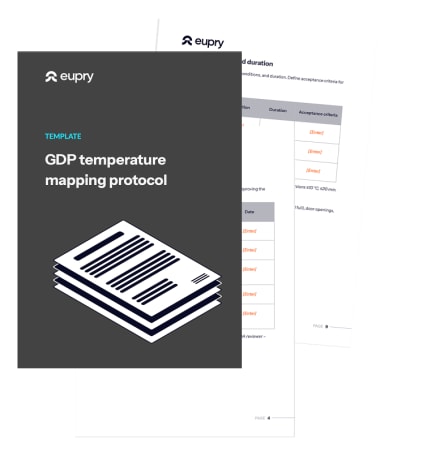
Download a GDP mapping protocol template
Save time and avoid deviations with a ready-to-use protocol template. Define objectives, acceptance criteria, sensor plans, and reporting in line with GDP expectations – all in one structured document.
How does truck mapping differ from warehouse mapping?
The underlying principles – calibrated sensors, defined acceptance criteria, stress testing, and documented results – are the same. But trucks and trailers introduce specific challenges that change how you plan and execute the study.
Smaller volume, different airflow patterns: A standard 53-foot trailer has roughly 80–100 m³ (2,800–3,500 ft³) of cargo space. That is a fraction of a warehouse, but the airflow dynamics are more complex. The reefer unit blows cold air from the front, and air has to travel the full length of the trailer and return. Cargo stacking patterns, T-bar floor channels, and air chute conditions all affect distribution.
Shorter study windows: Warehouse mappings typically run 7–14 days. Truck mappings are usually shorter – often 24–72 hours per test condition – because the vehicle needs to return to service. This means your protocol needs to be tightly planned, and your mapping equipment needs to capture data at intervals short enough (typically 1–5 minutes) to detect brief excursions during stress tests.
Operational disruption is expensive: Every day a truck is parked for mapping is a day it cannot deliver. For fleets of 20, 50, or 100+ vehicles, mapping logistics become a project management challenge. Wireless data loggers that transmit in real time reduce the need for manual data downloads and allow remote monitoring during studies.
Ambient conditions are uncontrolled: Unlike a warehouse with a fixed HVAC system, a truck on the road faces external temperature changes as it moves through different climates, elevations, and weather conditions during a single trip.
Also read: GDP-compliant reefer container temperature mapping
How many sensors do you need for a truck or trailer?
There is no single regulatory number. The sensor count depends on the vehicle size, the risk profile, and the level of detail your pharma customers or auditors require.
As a practical starting point, industry practice for a standard truck or trailer typically calls for 8–20 sensors. This range comes from guidance in WHO TRS 961 and ISPE standards, adapted for vehicle dimensions.
A common approach for a standard trailer uses a three-dimensional grid covering length, width, and height:
- Length: Head (near the reefer unit), middle, and tail (near the doors) – at minimum three zones
- Width: Left side, center, and right side
- Height: Floor level, mid-height (pallet top), and ceiling level
That gives you a baseline of 9 positions. Add sensors at specific risk points – near the door seals, at the reefer air supply and return, and near any partition walls in multi-temperature setups – and you typically land in the 12–18 range for a standard trailer.
For smaller vans or box trucks, 8–12 sensors may be sufficient. For multi-temperature vehicles with separate compartments, each zone needs its own grid.
One additional sensor should be placed outside the vehicle to record ambient temperature during the study. This provides context for any excursions and is expected in the final report.
Also read: Where to place data loggers during temperature mapping
Where should you place sensors in a truck or trailer?
Sensor placement follows the same risk-based logic as any mapping study, but trucks have specific risk zones that require attention.
Near the rear doors: This is typically the warmest area in the trailer. It is farthest from the reefer unit, exposed to heat ingress every time the doors open, and often the last spot to recover after a loading event. At least two sensors should cover this zone – one near the top and one near the floor.
Near the reefer unit air supply: The area directly in front of the reefer unit is usually the coldest. Sensors here verify that the unit is not overcooling product near the supply outlet – a freezing risk for products stored at +2 °C to +8 °C (+36 °F to +46 °F).
Along the ceiling and floor: Cold air typically flows along the ceiling from front to rear, then returns along the floor through the T-bar channels. Sensors at ceiling and floor level at multiple points along the length capture this circulation pattern and detect any dead zones where air does not reach.
Near partition walls (multi-temp setups): If the trailer has a movable bulkhead creating separate temperature zones, place sensors on both sides of the partition. Temperature bleed between zones is a common audit finding.
On or near cargo (loaded test only): During a loaded mapping, placing sensors between pallets or cartons – rather than only on walls – shows the temperature the product actually experiences. This is particularly important for dense, tightly packed loads that restrict airflow.
Photograph and label every sensor position with its unique ID before starting the study. Auditors expect a schematic showing where each sensor was placed and the rationale for that location.
What stress tests does a truck mapping require?
A GDP-compliant truck mapping protocol typically includes four to five test conditions. The goal is to challenge the vehicle under representative and worst-case scenarios, then verify it recovers within acceptable limits.
Steady-state test (empty): Run the reefer unit with the empty trailer closed until all sensors reach a stable temperature within the target range (for example, +2 °C to +8 °C / +36 °F to +46 °F). Record for a defined period, often 4–12 hours, to establish baseline uniformity. This is your Operational Qualification (OQ) foundation.
Door-opening test: Simulate real-world loading and unloading by opening the rear doors for a defined duration and frequency – for example, 5–10 cycles of 30–60 seconds each. Record how quickly each sensor location returns to the target range after the doors close. This test often reveals the biggest variability between sensors.
Power failure/reefer shutdown test: Turn off the refrigeration unit and record how long the trailer maintains temperatures within the acceptable range. This tells you how much time you have if the reefer unit fails on the road before the product is at risk. Recovery time after restart should also be recorded.
Loaded test (Performance Qualification): Repeat key tests with the trailer loaded to a representative level – typically 50–75% capacity with thermal mass that simulates the product. A loaded trailer behaves differently from an empty one: thermal mass stabilizes temperatures but can also create airflow obstructions. This is your PQ evidence.
Hot soak / pre-cool test (optional but recommended): Park the vehicle in direct sun or a warm environment, then start the reefer unit and record how long it takes to pull down to the target range from an elevated starting temperature. This is particularly relevant for operations in warm climates or for vehicles that sit idle between runs.
Define your acceptance criteria before starting. Common criteria include: all sensors within the target range during steady state, recovery to the target range within a specified time (for example, 15–30 minutes) after door openings, and a minimum hold time after power failure.
Also see: Guide: Understanding acceptance criteria in mapping
Calculate the number of loggers you need for truck mapping in 30 seconds
- and see where to place them
Are you using too few or too many loggers - and are they in the right place? Wrong placement is a common mapping error. Visualize your grid in 3D with the Eupry’s Sensor Placement Planner based on WHO guidelines – and catch gaps before you write the protocol.

Do you need to map every truck or can you map by model?
This is one of the most common questions from fleets managing 20, 50, or 100+ vehicles, and the answer depends on your risk assessment.
Most regulatory frameworks allow a representative approach if you can justify it. If you have a fleet of identical vehicles – same manufacturer, same model, same reefer unit, same insulation type, and same age bracket – you can map a representative sample and extend the results to the rest of the fleet.
The key word is "justify." Your risk assessment documentation needs to explain why the vehicles are equivalent and why the sample size is representative. Factors that break equivalence include different reefer units, significant differences in vehicle age (older insulation degrades), different cargo configurations, and different operating routes or climate zones.
A common approach: map 100% of the first batch to establish your baseline, then use a sample-based approach (for example, 1 in 5 or 1 in 10) for subsequent vehicles added to the fleet, provided they are the same model and configuration.
Any vehicle that has undergone significant modification – reefer unit replacement, insulation repair, partition changes – needs its own mapping regardless of the fleet approach.
How long should a truck mapping study last?
Truck mappings are most often shorter than warehouse studies. A complete study covering all test conditions typically takes 2–4 days per vehicle. Here is a rough breakdown:
Steady-state (empty): 4–12 hours once the target temperature is reached.
Door-opening test: 2–4 hours, depending on the number of cycles.
Power failure test: Run until temperatures exceed acceptance criteria, then restart and record recovery. Often 2–6 hours total.
Loaded test: 8–24 hours under steady state with a representative load, plus door-opening and possibly power-failure repeats.
Some organizations run the empty and loaded tests on consecutive days to minimize downtime. Set your data logger sampling interval to 1–5 minutes – truck studies need higher resolution than the 5–15 minute intervals typical for warehouses.

Is seasonal mapping required for trucks and trailers?
EU GDP guidelines explicitly require that vehicle mapping accounts for seasonal variations. In practice, this means mapping during both summer and winter extremes – or at minimum, during the most challenging season for your operation.
Summer is usually the higher-risk season: external temperatures of +35 °C to +45 °C (+95 °F to +113 °F) stress the reefer unit, lengthen recovery times, and increase hot spot risk near walls and ceiling. Winter brings the opposite problem – overcooling and freezing risk, especially for +2 °C to +8 °C (+36 °F to +46 °F) products when ambient temperatures drop below the target range.
If you can only do one seasonal study initially, choose the highest-risk season for your products and plan the second within six months.
Truck mapping vs. lane qualification: What is the difference?
These are related but distinct exercises, and confusing them is a common audit finding.
Truck (vehicle) mapping qualifies the vehicle itself: can this trailer maintain +2 °C to +8 °C (+36 °F to +46 °F) under defined stress conditions? The study is performed under controlled conditions, typically with the vehicle parked.
Lane qualification qualifies a specific transportation route: does product moving from point A to point B stay within limits across the full journey, including handoffs, transit, customs holds, and delivery?
You need both. A perfectly mapped truck can still produce excursions if the route includes a 4-hour customs hold in an uncontrolled environment. The proposed USP <1079.5> specifically addresses lane qualification and is expected to formalize these requirements. If you operate in the US market, this is worth tracking alongside USP <1079.2> on excursion evaluation.
What documentation do auditors expect for truck mappings?
The mapping report is audit evidence. It needs to stand on its own without verbal explanation.
At a minimum, auditors expect:
- Approved protocol: Signed before the study begins, covering objectives, acceptance criteria, sensor plan, and test conditions.
- Sensor plan with schematic: Diagram or photograph showing each sensor position, its ID, and the rationale.
- Calibration certificates: For every logger, with calibration traceable to national or international standards (for example, NIST, ILAC-MRA). Must be current at the time of the study.
- Raw data: Complete, unedited readings from all sensors with timestamps.
- Analysis and report: Min, max, mean, and standard deviation per sensor. Graphical profiles and excursion tables with duration and root cause.
- Deviation log: Any deviations from the protocol, with impact assessment and corrective action.
- Conclusion and recommendations: Pass/fail, recommended monitoring sensor locations, and re-mapping triggers.
All data should comply with ALCOA+ principles. Digital systems that meet FDA 21 CFR Part 11 requirements simplify this with automatic audit trails and tamper-evident records.
Covers all 13 sections auditors look for, with placeholders and sample values.

When do you need to re-map your truck or trailer?
An initial mapping qualifies the vehicle at a point in time. Re-mapping is required when something changes that could affect thermal performance.
Common triggers:
- Reefer unit replacement or major repair: Any change to the refrigeration system requires re-validation.
- Insulation damage or repair: Dents, holes, or worn door seals alter thermal performance.
- Configuration changes: Adding or removing partition walls, changing the air chute, or modifying cargo-securing equipment.
- Significant age deterioration: A risk-based schedule – for example, every 2–3 years or based on monitoring trends – is common.
- Audit findings or excursion trends: A pattern of excursions in a previously mapped vehicle warrants investigation.
- Change of product type: Moving from controlled room temperature to cold chain means the vehicle needs qualification for the new range.
If you use a fleet-level approach, a re-mapping trigger on one vehicle should prompt a risk assessment across equivalent vehicles.