Cleanroom classifications: ISO 14644-1, EU GMP grades, and FDA requirements
Cleanroom classification confirms a controlled environment meets a particle limit. ISO 14644-1, EU GMP Annex 1, and FDA cGMP all define those limits, but not identically.
All the classification numbers you need for audits, deviations, and design.
Table of contents
What is cleanroom classification?
Cleanroom classification is the process of measuring airborne particle concentration in a controlled environment and comparing those measurements against a defined standard. The result is an assignment to a specific class (ISO 1 through 9) or grade (A through D) that describes the maximum number of particles allowed at specified sizes per cubic meter of air.
Three frameworks define classification limits in pharmaceutical contexts:
- ISO 14644-1:2015: The international standard published by the International Organization for Standardization. Current operative version, last reviewed and confirmed in 2021.
- EU GMP Annex 1 (2022): The European pharmaceutical regulation that references ISO 14644-1 but adds operational state distinctions and microbial contamination requirements.
- Federal Standard 209E: The US standard formally superseded in 2001 but still in active use in legacy facility documentation, FDA guidance language, and informal pharma shorthand.
The three frameworks describe the same physical reality through different conventions, which is the main source of confusion. A "Class 100" cleanroom under Federal Standard 209E is approximately an ISO 5 cleanroom under ISO 14644-1, which corresponds to a Grade A or Grade B environment under Annex 1 depending on the operational state.
Is cleanroom classification the same as qualification?
No. Classification is a single measurement test: count particles at designated sample locations, compare against the table, assign a class. Qualification is the broader process of demonstrating a cleanroom is fit for its intended use, and typically follows the DQ, IQ, OQ, PQ structure. Classification is one input within qualification, alongside airflow visualization, recovery testing, HEPA filter integrity, pressure differentials, and viable monitoring.
Validation sits above both as the umbrella process, combining qualification evidence with ongoing monitoring, calibration, and mapping into one documented life cycle.
ISO 14644-1: The international classification standard
ISO 14644-1 is the global standard for cleanroom classification. The current version, ISO 14644-1:2015, replaced Federal Standard 209E on 29 November 2001 and remains the operative version as of 2026.
The standard defines nine classes of air cleanliness based on the maximum concentration of airborne particles at specified size thresholds. ISO 1 is the most stringent, with a maximum of 10 particles ≥0.1 µm per cubic meter. ISO 9 is the least stringent, equivalent to normal indoor air in many environments.
Pharmaceutical cleanrooms typically operate in the ISO 5 to ISO 8 range. ISO 5 is required for aseptic processing of sterile products. ISO 7 and ISO 8 are used for surrounding areas, component preparation, and less critical manufacturing stages.

ISO 14644-1 particle concentration limits
Dashes indicate a size and class combination not classified under ISO 14644-1:2015. The 2015 revision removed the ≥5 µm column for ISO 5 because macro-particle concentrations at that level are not reliably measurable with the discrete airborne particle counters used for classification.
Classification uses light-scattering discrete airborne particle counters at designated sample locations. The 2015 revision moved from a formula-based sampling approach to a table-based approach and removed the upper confidence limit calculation for rooms with one to nine sample points.
ISO 14644-1 is part of a broader series. ISO 14644-2 covers monitoring of cleanroom performance over time, and ISO 14644-3 covers test methods such as airflow visualization, recovery, and filter integrity.

ISO class | ≥0.1 µm | ≥0.2 µm | ≥0.3 µm | ≥0.5 µm | ≥1 µm |
ISO 1 | 10 | – | – | – | – |
ISO 2 | 100 | 24 | 10 | – | – |
ISO 3 | 1,000 | 237 | 102 | 35 | – |
ISO 4 | 10,000 | 2,370 | 1,020 | 352 | 83 |
ISO 5 | 100,000 | 23,700 | 10,200 | 3,520 | 832 |
ISO 6 | 1,000,000 | 237,000 | 102,000 | 35,200 | 8,320 |
ISO 7 | – | – | – | 352,000 | 83,200 |
ISO 8 | – | – | – | 3,520,000 | 832,000 |
ISO 9 | – | – | – | 35,200,000 | 8,320,000 |
Note: ISO 14644-1:2015 also defines ≥5 µm limits for classes ISO 6 through 9 (293, 2,930, 29,300, and 293,000 particles per m³ respectively). These are included in the downloadable reference document.
EU GMP Annex 1: grades A, B, C, and D
EU GMP Annex 1 governs the manufacture of sterile medicinal products in the European Union. The current version was published in August 2022 and took effect on 25 August 2023, with section 8.123 effective from 25 August 2024.
Annex 1 references ISO 14644-1 for particle counts but adds two requirements that ISO does not address: operational state distinctions (at rest and in operation) and microbial contamination limits.
Grade | At rest, ≥0.5 µm | In operation, ≥0.5 µm | ISO equivalent (at rest / in operation) |
A | 3,520 | 3,520 | ISO 5 / ISO 5 |
B | 3,520 | 352,000 | ISO 5 / ISO 7 |
C | 352,000 | 3,520,000 | ISO 7 / ISO 8 |
D | 3,520,000 | Defined by CCS | ISO 8 / CCS-defined |
Each grade is tied to specific manufacturing activities:
- Grade A: Critical aseptic operations such as sterile filling, compounding, and open transfer of sterile product or components. Typically maintained under unidirectional airflow within an isolator or restricted access barrier system (RABS).
- Grade B: Background environment for Grade A during aseptic preparation and filling. The at-rest classification matches Grade A (ISO 5), but the in-operation limit relaxes to ISO 7 because personnel activity generates particles.
- Grade C: Less critical clean areas where components, solutions, or equipment are prepared before sterilization or aseptic processing.
- Grade D: Least stringent grade, used for handling components after washing and for bulk material preparation. The in-operation particle limit is set by the facility's contamination control strategy based on a documented risk assessment.
Microbial contamination limits
In addition to particle counts, Annex 1 specifies microbial limits in operation across four sampling methods.
| Grade | Active air (CFU/m³) | Settle plate, 90 mm (CFU/4 hours) | Contact plate, 55 mm (CFU/plate) | Glove print, 5 fingers (CFU/glove) |
|---|---|---|---|---|
| A | <1 | <1 | <1 | <1 |
| B | 10 | 5 | 5 | 5 |
| C | 100 | 50 | 25 | – |
| D | 200 | 100 | 50 | – |
Grade A is the most stringent: any recovered organism is treated as a deviation requiring investigation. Continuous viable air sampling is expected in Grade A zones where the contamination risk is highest.
What changed in the 2022 revision
The 2022 revision introduced several substantive changes:
- Contamination control strategy (CCS): A documented, facility-wide strategy covering design, gowning, airflow, surface disinfection, and environmental monitoring is now required.
- Revised ≥5 µm particle treatment: The classification handling of ≥5 µm particles for Grades A and B was revised. Monitoring of macro particles remains expected, with thresholds informed by the CCS.
- Continuous monitoring expectations: Tighter expectations for continuous monitoring of differential pressure and viable contamination, particularly in Grade A and Grade B zones.
- Risk-based justification: Expanded role for documented risk assessment across qualification, monitoring, and revalidation.
Also read: Differential pressure monitoring in pharmaceutical cleanrooms
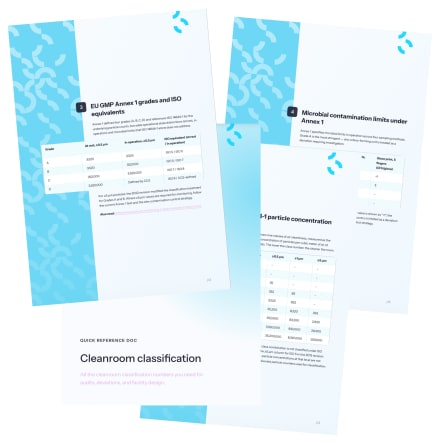
Download a cleanroom classification reference doc
One document, all the cleanroom classification numbers you need for audits, deviations, and facility design.
FDA cGMP cleanroom requirements
The US Food and Drug Administration does not publish a separate cleanroom grading system. FDA cGMP regulations under 21 CFR Parts 210 and 211 require adequate environmental controls in manufacturing areas without prescribing specific particle limits.
For sterile drug manufacturing, the FDA's Guidance for Industry: Sterile Drug Products Produced by Aseptic Processing (2004) uses ISO 14644-1 classes directly. ISO 5 corresponds to the critical aseptic processing zone (equivalent to Annex 1 Grade A), ISO 7 to the surrounding area, and ISO 8 to less critical clean areas.
In practice, FDA inspectors evaluate whether:
- The design matches the URS: Cleanroom classification aligns with the user requirement specification.
- Particle monitoring covers production: Data demonstrates the room meets its assigned classification during operation, not only at rest.
- Records are protected: Environmental monitoring records are time-stamped, audit-trailed, and protected against modification under 21 CFR Part 11.
- Deviations are investigated: Excursions are documented, root cause is identified, and corrective action is implemented.
The FDA's 2025 fiscal year set a 20-year record for warning letters, with environmental monitoring deficiencies cited in more than 15 percent of them. Common findings include monitoring gaps between scheduled qualification cycles, single-parameter monitoring against multi-parameter URS requirements, and data integrity issues with manual records.
Also read: What is 21 CFR Part 11?

Federal Standard 209E: The legacy reference still in use
Federal Standard 209E was the US cleanroom classification standard until 29 November 2001, when it was superseded by ISO 14644-1. The standard remains in active use because:
- Older facility documentation and SOPs still reference it
- FDA guidance language and informal pharma shorthand uses Class 100, Class 10,000, and similar terminology
- Some particle counters still display results in particles per cubic foot, the FED 209E unit
- QA staff trained under the previous standard continue to use the older terminology
FED 209E classified cleanrooms by the number of particles ≥0.5 µm per cubic foot of air.
FED 209E class | Particles per ft³ at ≥0.5 µm | Approximate ISO equivalent |
Class 1 | 1 | ISO 3 |
Class 10 | 10 | ISO 4 |
Class 100 | 100 | ISO 5 |
Class 1,000 | 1,000 | ISO 6 |
Class 10,000 | 10,000 | ISO 7 |
Class 100,000 | 100,000 | ISO 8 |
The equivalence is approximate because FED 209E used cubic feet and ISO 14644-1 uses cubic meters. A "Class 100" cleanroom remains the most commonly referenced legacy designation in pharmaceutical contexts, corresponding to ISO 5 and the level required for aseptic filling.
The three cleanroom states
ISO 14644-1 defines three operational states. Auditors and inspectors use the state to interpret classification results and ongoing monitoring data.
- As built: Cleanroom is complete with all services connected and operating, but production equipment is not installed, and no personnel are present. Used during initial commissioning.
- At rest: All services and production equipment are installed and operating, but no personnel are present, and no production activity is taking place. Used for classification testing under ISO 14644-1 and for the at-rest limits in Annex 1.
- In operation: All equipment is operating, personnel are present, and the cleanroom is performing its intended activity. Used for routine environmental monitoring under Annex 1 in-operation limits.
The distinction matters during audits. Classification testing typically happens at rest, when particle levels are lowest, and the room performs to its design specification. Auditors then look for in-operation monitoring evidence that the room continues to perform during actual manufacturing. A facility that passes at-rest classification but cannot demonstrate consistent in-operation control is at risk of a 483 observation, even when the most recent classification certificate is current.
Classification vs. monitoring: What the standards actually require
Classification is a point-in-time exercise. A particle counter takes measurements at designated locations, data is compared against the relevant table, and the room is certified to a specific class or grade. The certificate is valid until the next scheduled requalification, typically 6 or 12 months later, depending on grade.
Monitoring is the ongoing assurance that the room continues to perform between qualification cycles. ISO 14644-2 covers monitoring methodology separately from classification, and EU GMP Annex 1 requires continuous monitoring for critical parameters in Grade A and Grade B zones.
In pharmaceutical contexts, cleanroom monitoring typically covers:
- Non-viable particle counts: Continuous in Grade A and Grade B, periodic in lower grades
- Viable particles: Active air sampling, settle plates, contact plates, and glove prints, with frequency tied to grade
- Differential pressure: Continuous for critical room-to-room pressure cascades
- Temperature and humidity: Continuous, with alarm thresholds tied to product stability requirements
- CO₂ where applicable: For specific manufacturing processes and incubator-adjacent operations
A classification certificate confirms the room can perform to specification. Monitoring evidence confirms the room did perform during production. Auditors expect both.
How often must cleanrooms be reclassified?
EU GMP Annex 1 expects periodic requalification at maximum intervals tied to grade, with the schedule adjusted based on a documented risk assessment and the contamination control strategy.
- Grade A and B: Typically every 6 months
- Grade C and D: Typically every 12 months
Requalification is also triggered by:
- Significant HVAC modifications
- Room layout or partition changes
- Recurring monitoring excursions in the same zone
- Contamination events or product impact deviations
- Changes to the contamination control strategy
ISO 14644-1 itself does not prescribe a requalification frequency; it provides the methodology. Annex 1, FDA cGMP expectations, and the site's contamination control strategy define when requalification happens in practice.
Also read: Equipment qualification under IQ, OQ, and PQ

What auditors look for in cleanroom classification evidence
Inspectors and notified body auditors evaluate cleanroom classification on a small number of structural questions. The classification certificate alone does not satisfy these; it needs to be backed by a documented system.
- Risk-based justification: Sample location selection, sample volumes, and frequency tied to a documented risk assessment, not a fixed protocol applied universally.
- State-appropriate testing: Classification performed at rest, monitoring evidence covering in operation. Both must be available and reconciled.
- Multi-parameter coverage: Where the URS specifies humidity, differential pressure, CO₂, or other parameters in addition to particles, the monitoring record must cover all of them. Single-parameter monitoring against a multi-parameter requirement is a recurring audit finding.
- Data integrity: Records protected under 21 CFR Part 11 and EU GMP Annex 11, with audit trails, electronic signatures, and time-stamped logs.
- Current monitoring data: Continuous evidence between qualification cycles, not only the most recent classification certificate.
The most common audit findings are not classification failures themselves. They are monitoring gaps: missing data during periods of active manufacturing, manual records that cannot be reconstructed, or partial-parameter coverage where the URS requires more.
Frequently asked questions about cleanroom classification

Maintain cleanroom classification with continuous monitoring
Classification is a point-in-time check. Maintaining the classification between qualification cycles requires continuous monitoring of particles, differential pressure, humidity, temperature, and microbial contamination, all under 21 CFR Part 11 and EU GMP Annex 11 data integrity requirements.
Eupry's environmental monitoring platform handles differential pressure, temperature, humidity, and CO₂ in one GxP-compliant system with audit reports in three clicks.